Use the buttons, dots, or your left/right arrow keys.
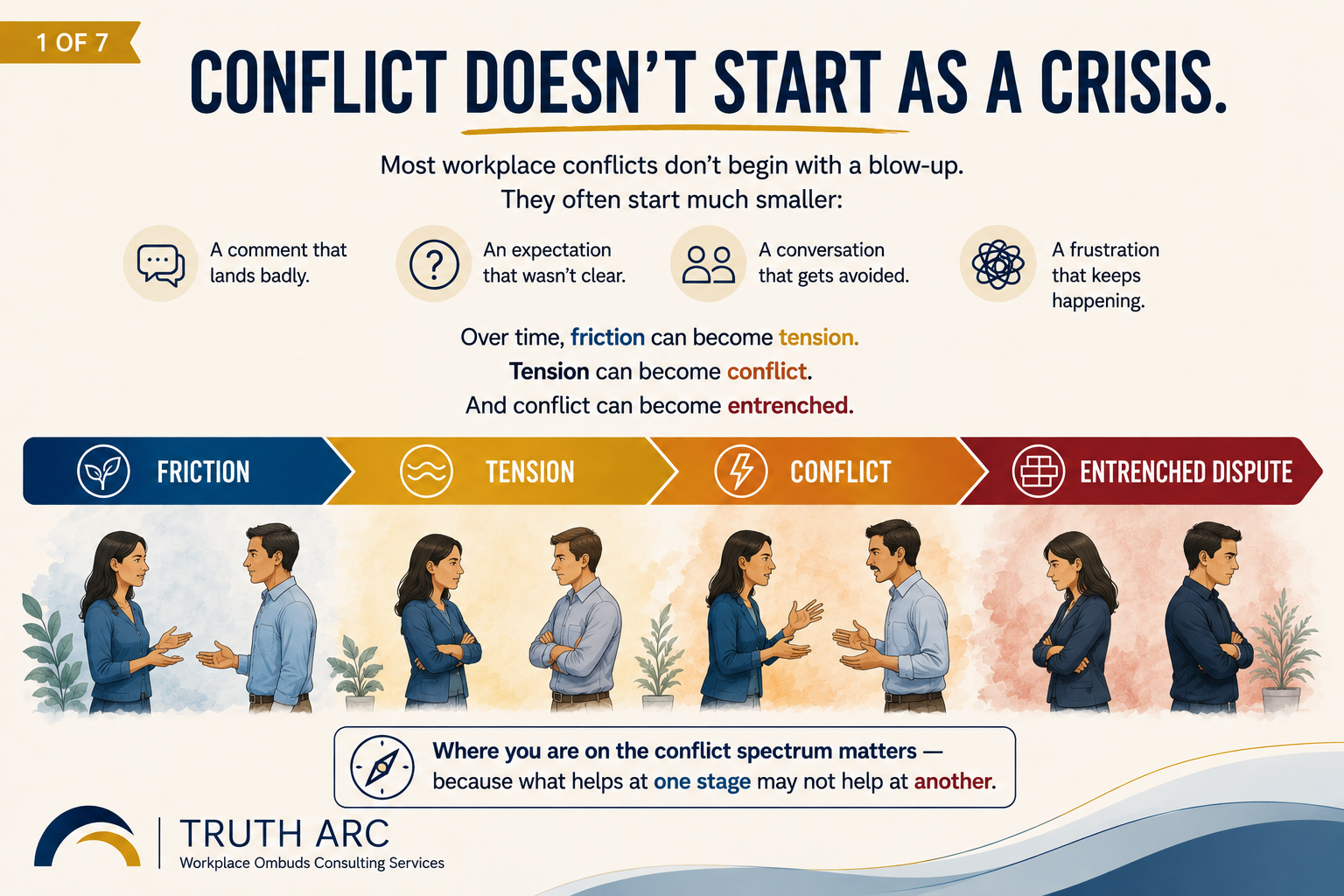
1/7 — Conflict Doesn’t Start as a Crisis
Most workplace conflicts don’t begin with a blow-up. They often start much smaller:
- A comment that lands badly.
- An expectation that wasn’t clear.
- A conversation that gets avoided.
- A frustration that keeps happening.
Over time, friction can become tension. Tension can become conflict. And conflict can become entrenched.
Where you are on the conflict spectrum matters — because what helps at one stage may not help at another.
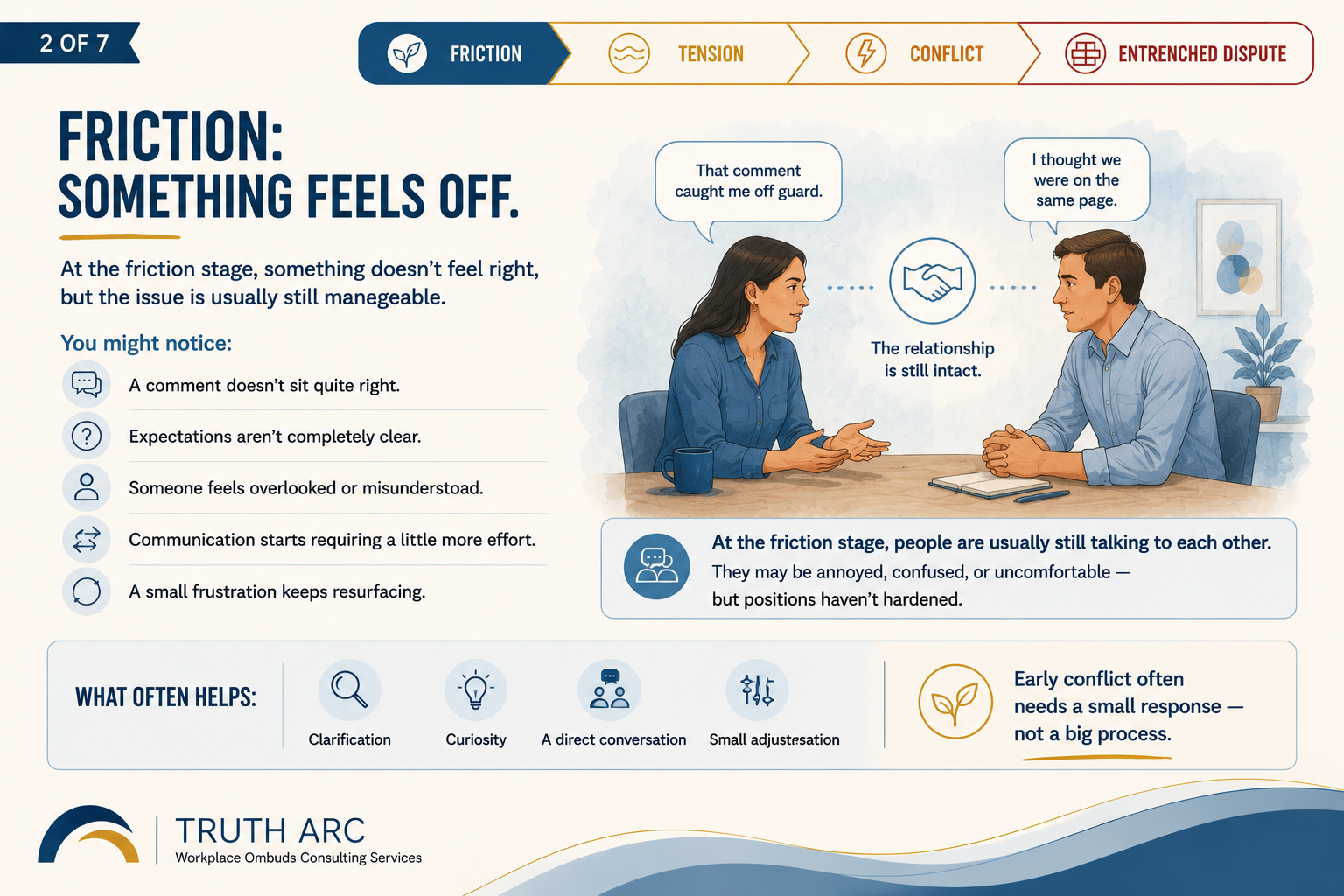
2/7 — Friction: Something Feels Off
At the friction stage, something doesn’t feel right, but the issue is usually still manageable.
You might notice:
- A comment doesn’t sit quite right.
- Expectations aren’t completely clear.
- Someone feels overlooked or misunderstood.
- Communication starts requiring a little more effort.
- A small frustration keeps resurfacing.
The relationship is still intact. People are usually still talking to each other. They may be annoyed, confused, or uncomfortable — but positions haven’t hardened.
What often helps: clarification, curiosity, a direct conversation, and small adjustments.
Early conflict often needs a small response — not a big process.
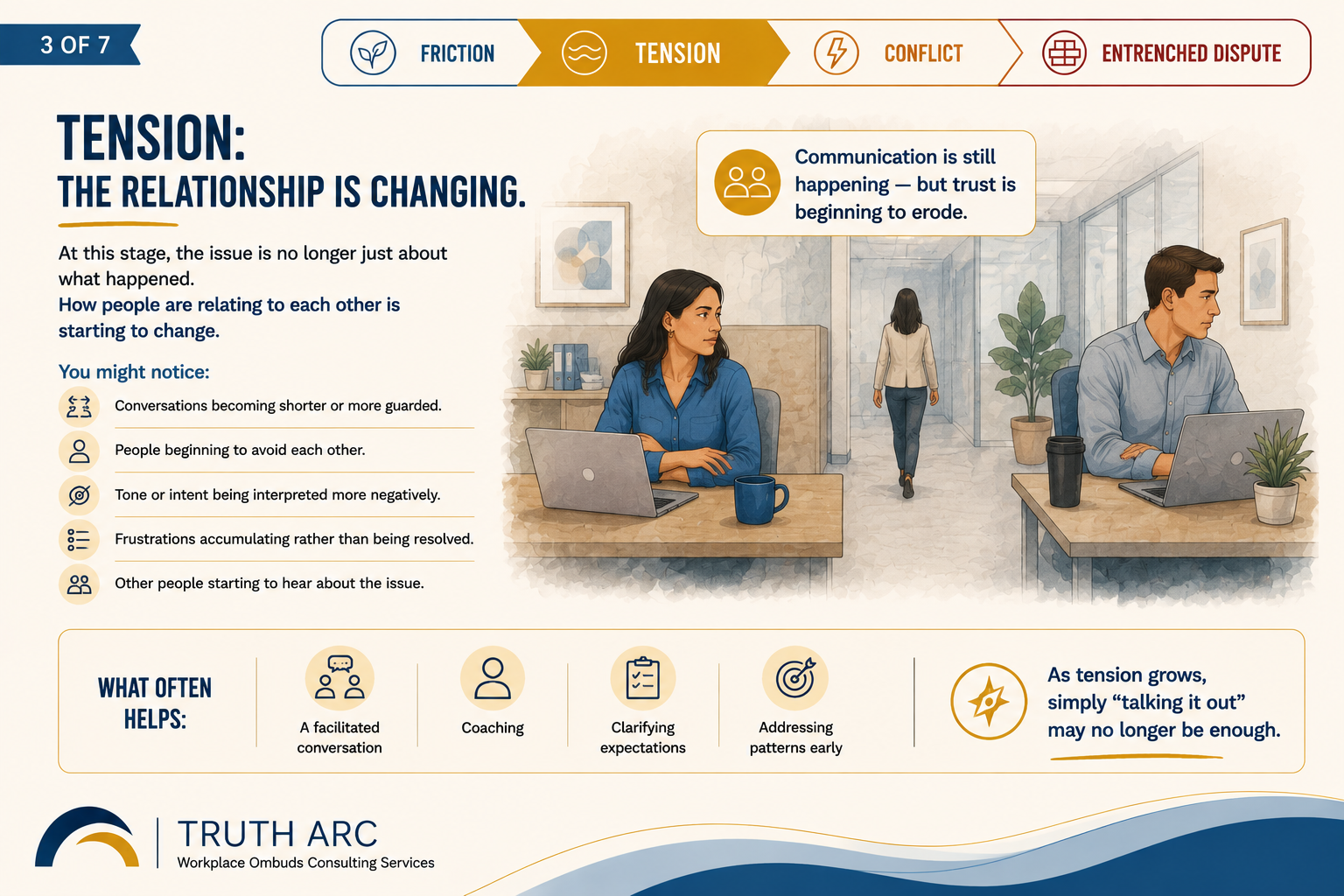
3/7 — Tension: The Relationship Is Changing
At this stage, the issue is no longer just about what happened. How people are relating to each other is starting to change.
You might notice:
- Conversations becoming shorter or more guarded.
- People beginning to avoid each other.
- Tone or intent being interpreted more negatively.
- Frustrations accumulating rather than being resolved.
- Other people starting to hear about the issue.
Communication is still happening — but trust is beginning to erode.
What often helps: a facilitated conversation, coaching, clarifying expectations, and addressing patterns early.
As tension grows, simply “talking it out” may no longer be enough.
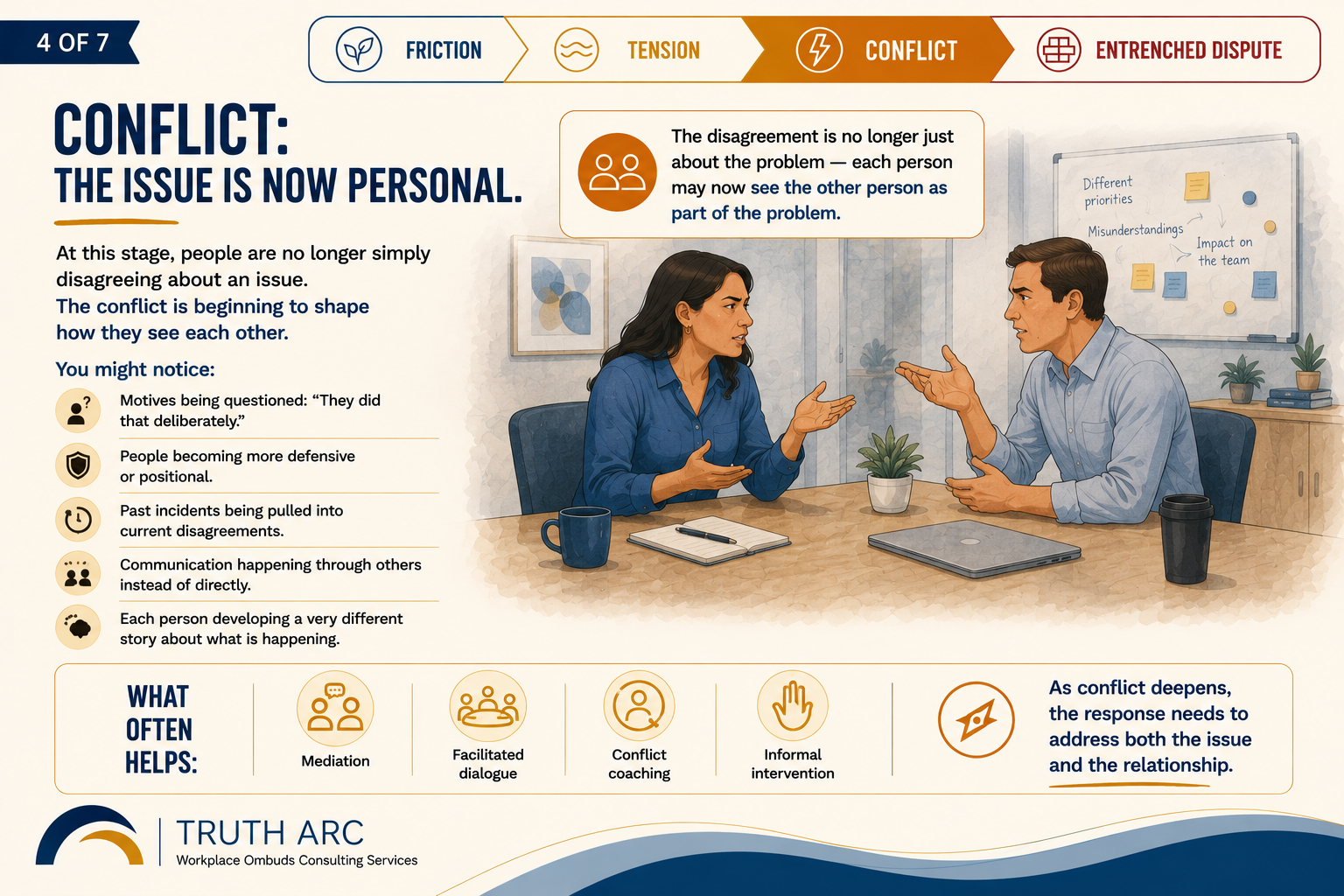
4/7 — Conflict: The Issue Is Now Personal
At this stage, people are no longer simply disagreeing about an issue. The conflict is beginning to shape how they see each other.
You might notice:
- Motives being questioned: “They did that deliberately.”
- People becoming more defensive or positional.
- Past incidents being pulled into current disagreements.
- Communication happening through others instead of directly.
- Each person developing a very different story about what is happening.
The disagreement is no longer just about the problem — each person may now see the other person as part of the problem.
What often helps: mediation, facilitated dialogue, conflict coaching, and informal intervention.
As conflict deepens, the response needs to address both the issue and the relationship.
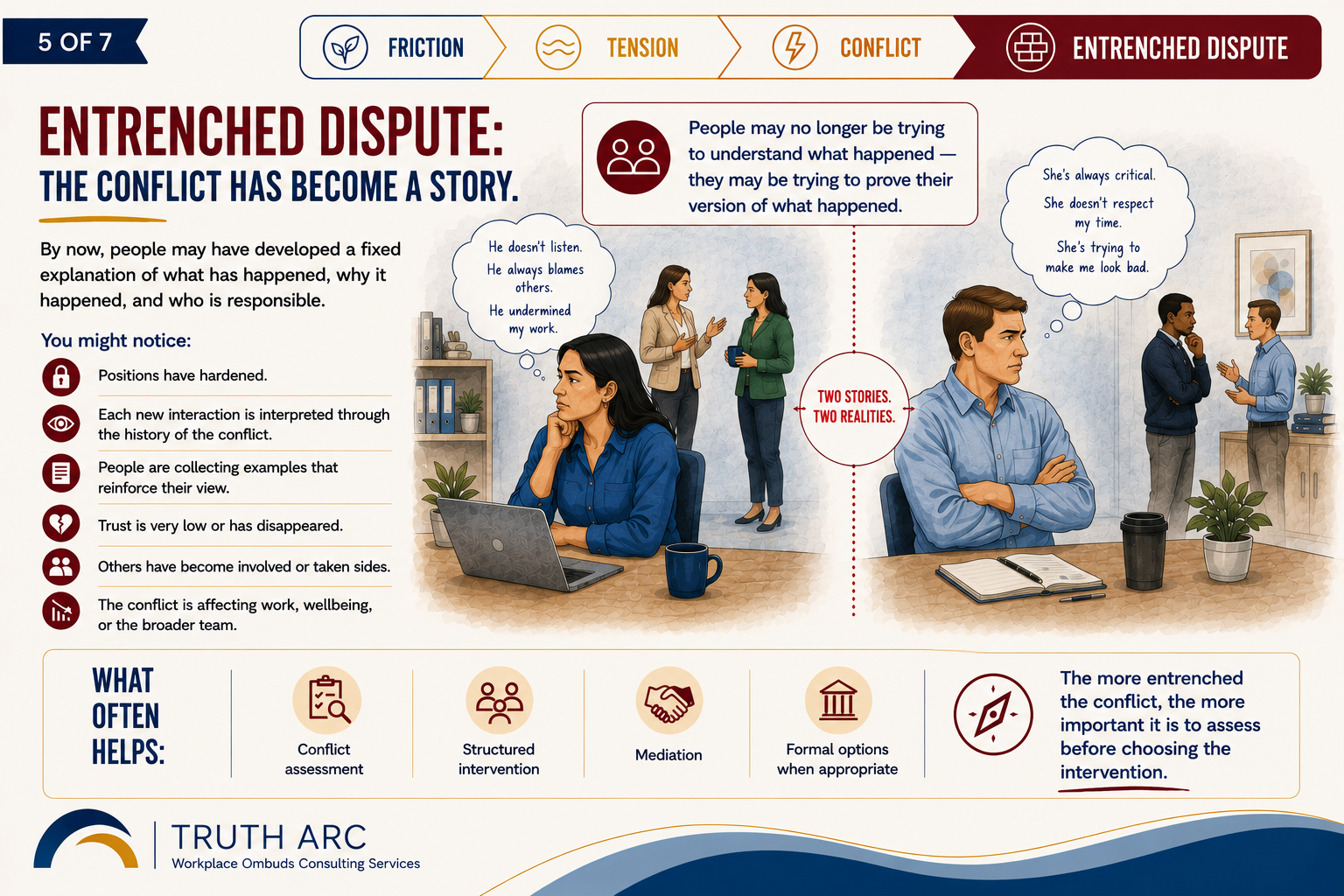
5/7 — Entrenched Dispute: The Conflict Has Become a Story
By now, people may have developed a fixed explanation of what has happened, why it happened, and who is responsible.
You might notice:
- Positions have hardened.
- Each new interaction is interpreted through the history of the conflict.
- People are collecting examples that reinforce their view.
- Trust is very low or has disappeared.
- Others have become involved or taken sides.
- The conflict is affecting work, wellbeing, or the broader team.
People may no longer be trying to understand what happened — they may be trying to prove their version of what happened.
What often helps: conflict assessment, structured intervention, mediation, and formal options when appropriate.
The more entrenched the conflict, the more important it is to assess before choosing the intervention.
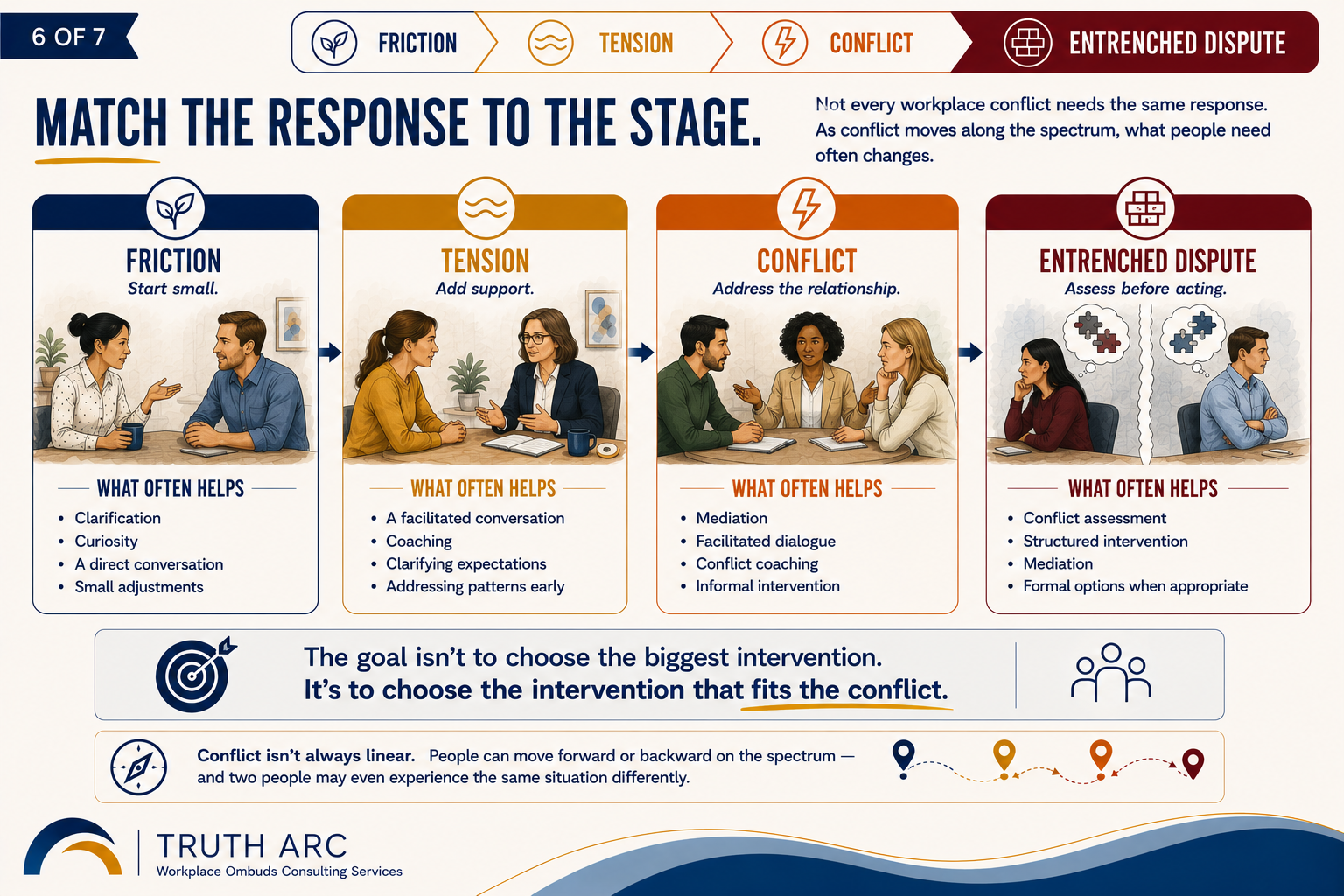
6/7 — Match the Response to the Stage
Not every workplace conflict needs the same response. As conflict moves along the spectrum, what people need often changes.
- Friction — Start small: clarification, curiosity, a direct conversation, small adjustments.
- Tension — Add support: a facilitated conversation, coaching, clarifying expectations, addressing patterns early.
- Conflict — Address the relationship: mediation, facilitated dialogue, conflict coaching, informal intervention.
- Entrenched dispute — Assess before acting: conflict assessment, structured intervention, mediation, formal options when appropriate.
The goal isn’t to choose the biggest intervention. It’s to choose the intervention that fits the conflict.
Conflict isn’t always linear. People can move forward or backward on the spectrum — and two people may even experience the same situation differently.
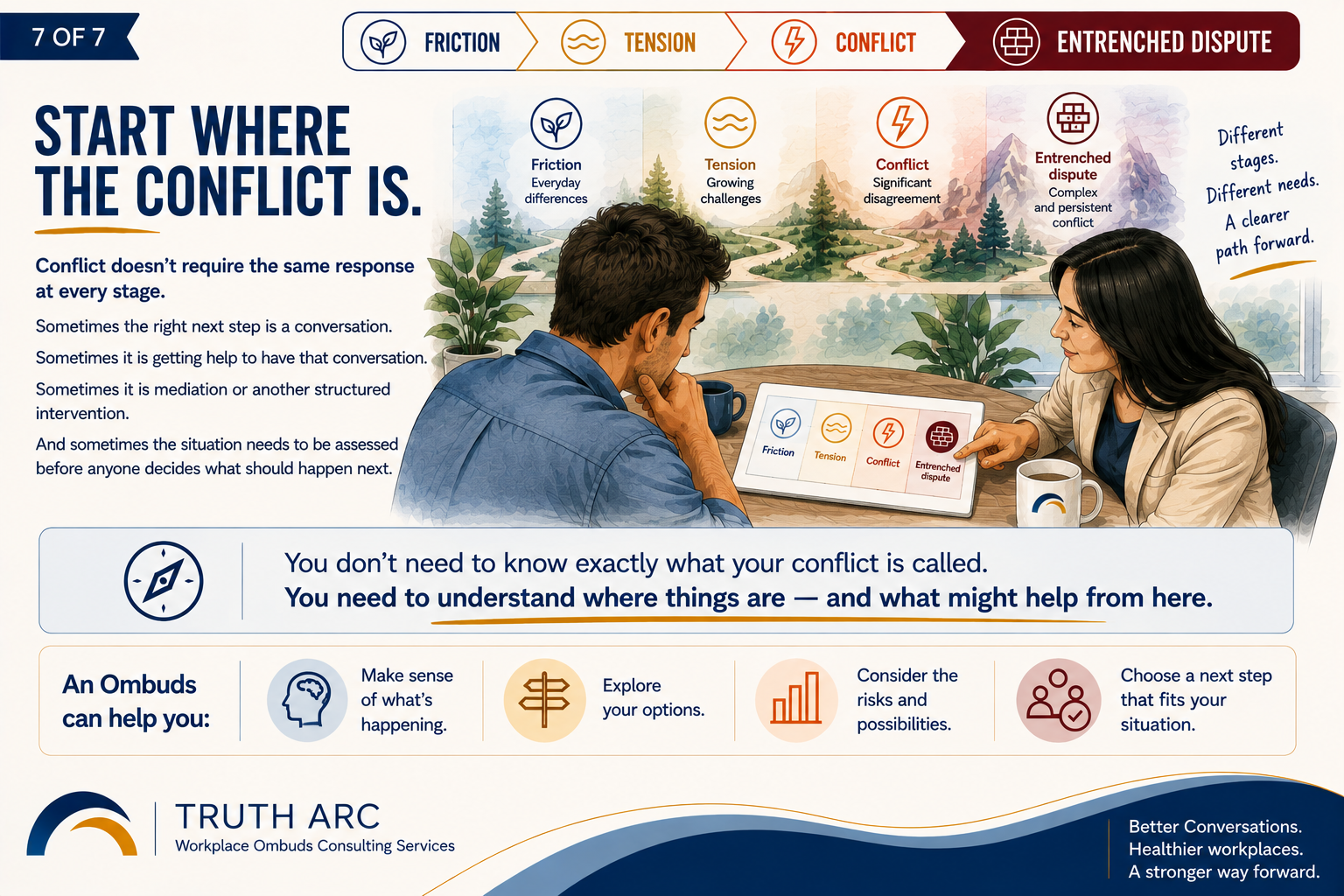
7/7 — Start Where the Conflict Is
Conflict doesn’t require the same response at every stage.
Sometimes the right next step is a conversation. Sometimes it is getting help to have that conversation. Sometimes it is mediation or another structured intervention. And sometimes the situation needs to be assessed before anyone decides what should happen next.
You don’t need to know exactly what your conflict is called. You need to understand where things are — and what might help from here.
An Ombuds can help you:
- Make sense of what’s happening.
- Explore your options.
- Consider the risks and possibilities.
- Choose a next step that fits your situation.
Start with where you are.