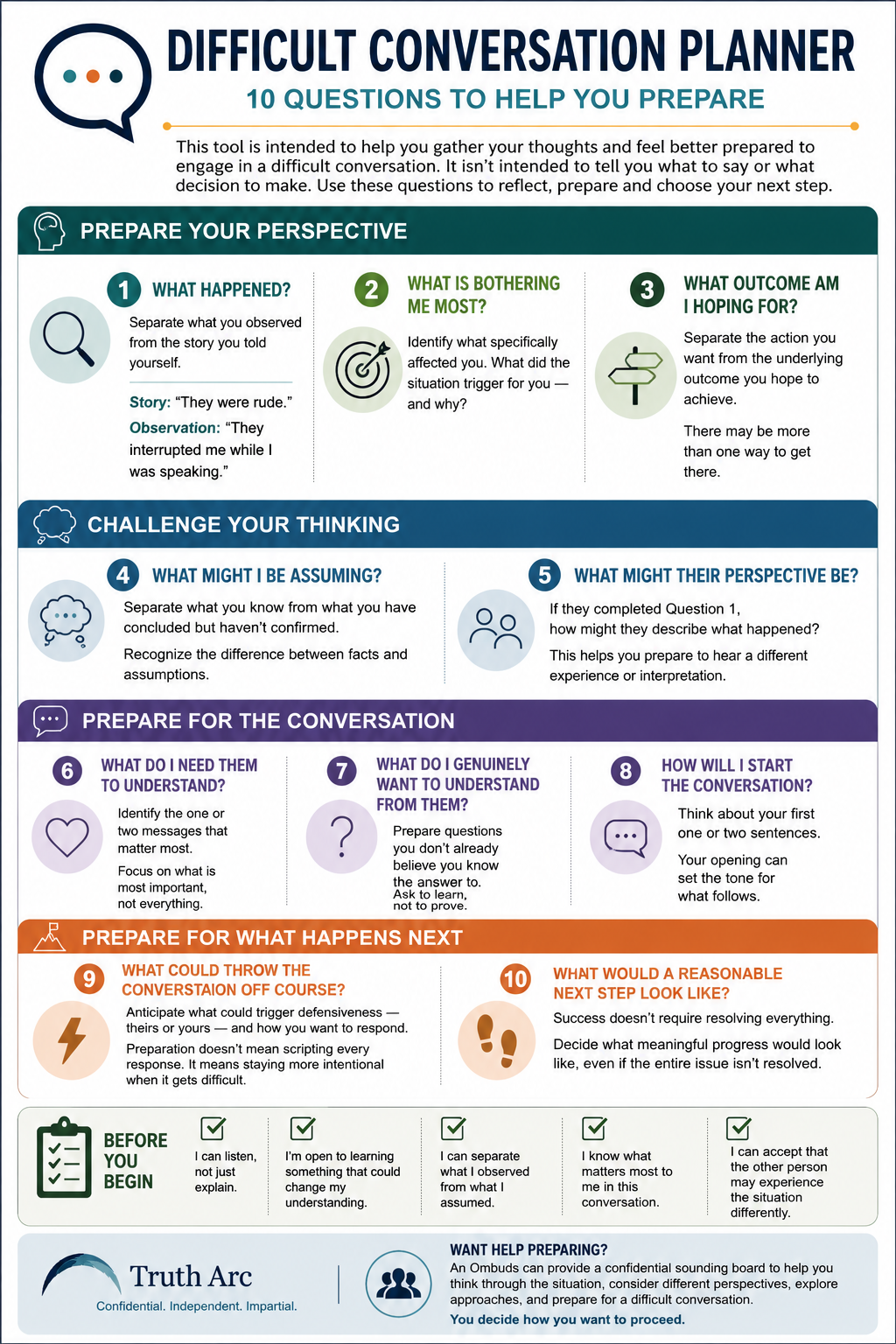
Text-Friendly Guide
Difficult conversations can be easier to navigate when you've had an opportunity to think through what happened, what matters to you, and what you hope to accomplish. This tool is intended to help you gather your thoughts and feel better prepared to engage in a difficult conversation. It isn't intended to tell you what to say or what decision to make. Instead, use the questions below to slow down, reflect on the situation, and prepare for the conversation you want to have.
1. What happened?
In conflict, we often mix our observations with the story we tell ourselves about what those observations mean. An important preparation activity is separating what you actually saw or heard from the conclusions you drew from it.
Story: “They were overbearing and rude.”
Observation: “I was speaking and they interrupted me mid-sentence.”
Try describing what happened in terms that someone observing the interaction could have seen or heard. You can always explore what the behaviour meant later.
Ask yourself: What did I actually see or hear?
2. What is bothering me most?
Sometimes a seemingly small action affects us much more strongly than we expect. Understanding what specifically bothered you can help identify what was triggered for you—not just who triggered it.
Perhaps being interrupted felt disrespectful. Being excluded from a meeting may have raised concerns about belonging or recognition. A delayed response might have left you feeling that your work wasn't valued.
Identifying the underlying trigger can help you prepare for this conversation, but it can also provide useful information for your own development. Ask yourself what made this particular behaviour matter to you and whether similar situations tend to produce the same reaction.
Ask yourself: What about this situation affected me most—and why?
3. What outcome am I hoping for?
Before entering a difficult conversation, it helps to distinguish between what you want the other person to do and what you ultimately want to accomplish.
For example, “I want them to apologize” is a specific action. The underlying outcome might be: “I want to feel that what happened was acknowledged and that it won't happen again.” There may be more than one way to achieve that outcome.
Knowing what matters most can make it easier to remain flexible about how you get there.
Ask yourself: If this conversation went reasonably well, what would be different afterward?
4. What might I be assuming?
When information is incomplete, we naturally fill in the gaps. We may make assumptions about someone's intentions, motivations, priorities, or reasons for behaving as they did.
“They didn't invite me because they don't respect my contribution” may feel true, but the observable fact may simply be: “I wasn't invited to the meeting.”
Your interpretation may ultimately prove correct. The purpose of this question isn't to dismiss it—it's to recognize what you know and what you may still need to learn.
Ask yourself: What conclusions have I reached that I haven't yet been able to confirm?
5. What might their perspective be?
Two people can experience the same interaction very differently. Before the conversation, consider how the other person might describe what happened.
This doesn't require you to agree with their perspective or excuse their behaviour. It simply prepares you to encounter information or interpretations that differ from your own.
Ask yourself: If they were completing this planner, what might they write under Question 1?
6. What do I need them to understand?
Difficult conversations can quickly become overloaded with examples, history, and competing issues. Decide what is most important for the other person to understand.
Try to identify one or two key messages rather than everything you could possibly say.
Ask yourself: What do I most want them to understand about my experience, concern, or needs?
7. What do I genuinely want to understand from them?
A difficult conversation isn't only an opportunity to explain your perspective. It's also an opportunity to obtain information you don't currently have.
Consider what you are genuinely curious about. The most useful questions are ones where you don't already believe you know the answer.
Instead of asking, “Why don't you respect my opinion?” you might ask: “What was happening for you when you interrupted me?”
Ask yourself: What am I genuinely curious to learn from them?
8. How will I start the conversation?
The opening moments can influence everything that follows. Starting with an accusation may invite defensiveness before you've had an opportunity to understand each other.
Consider an opening that briefly identifies what you'd like to discuss, why it matters to you, and your interest in hearing their perspective.
Ask yourself: What could my first one or two sentences be?
9. What could throw the conversation off course?
Difficult conversations rarely unfold exactly as planned. The other person may become defensive. You might hear something that frustrates you. An old issue may suddenly enter the conversation.
Think ahead about what might trigger you and how you want to respond if it happens. Preparation doesn't mean scripting every response—it means being more deliberate when the conversation becomes difficult.
Ask yourself: What could derail the conversation, and what could I do if it happens?
10. What would a reasonable next step look like?
Success doesn't always mean agreement, an apology, or resolving everything in one conversation.
Sometimes progress means understanding each other's perspectives better. Sometimes it's agreeing on one behavioural change. Sometimes it's simply identifying what needs to happen next.
Ask yourself: What would meaningful progress look like, even if the entire issue isn't resolved?
Before You Begin
- I can listen, not just explain.
- I'm open to learning something that could change my understanding of the situation.
- I can distinguish between what I observed and what I assumed.
- I know what matters most to me in this conversation.
- I can accept that the other person may experience the situation differently.