Use the buttons, dots, or your left/right arrow keys.
1/7 — A Place to Start
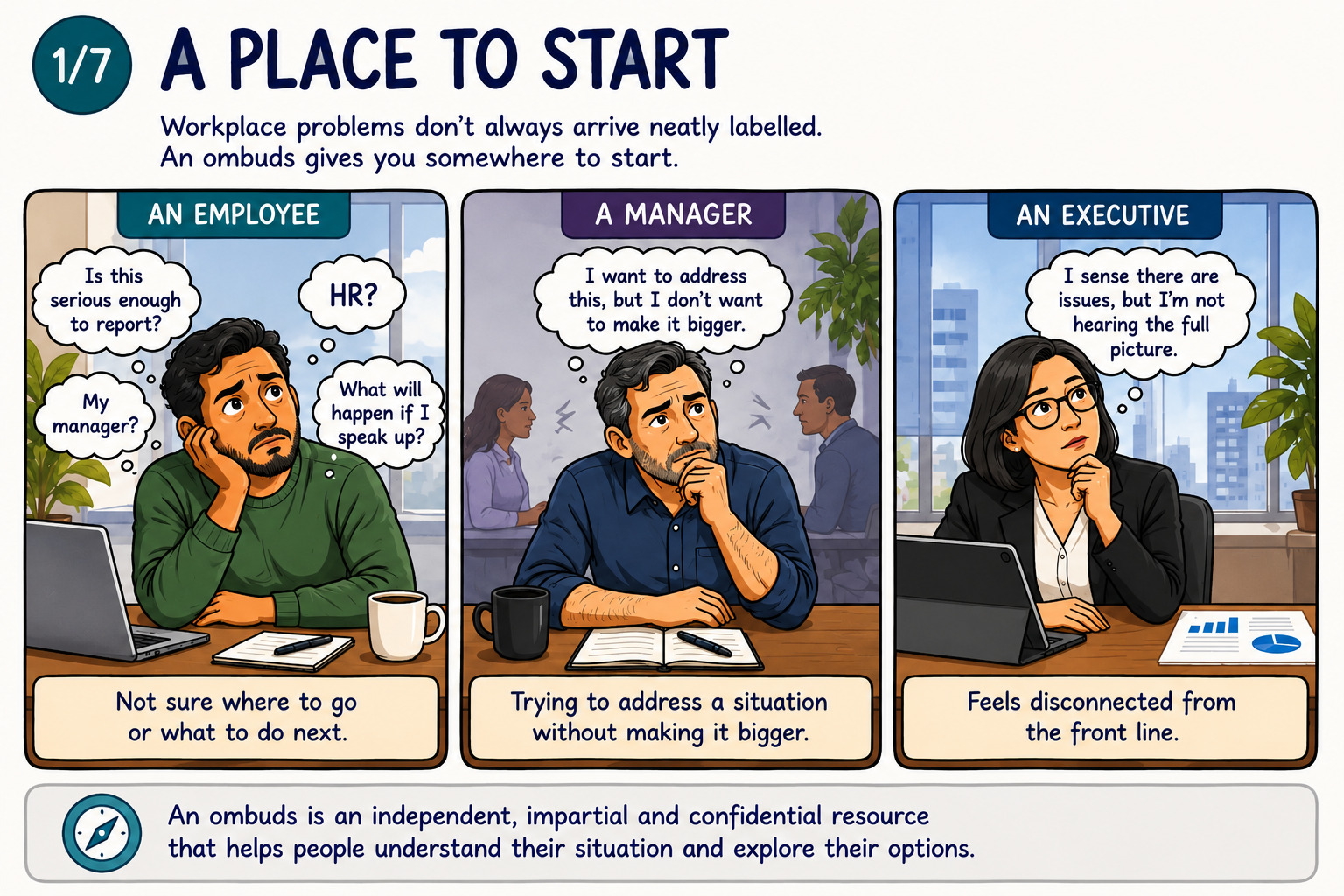
Workplace problems don't always arrive neatly labelled.
Sometimes an employee knows something isn't right but isn't sure what to do about it. Is the issue serious enough to raise? Should they speak with their manager? Contact Human Resources? Use a formal process? And what might happen if they speak up?
Managers face uncertainty too. They may see tension developing between employees, notice a relationship deteriorating, or recognize that something needs to be addressed — while worrying that intervening could make the situation worse.
Executives face a different challenge. The further they are from day-to-day operations, the harder it can be to know what employees are actually experiencing. Surveys, dashboards and formal complaints provide information, but they don't always reveal concerns that people aren't yet prepared to raise formally.
This is often where an Organizational Ombuds can help.
The Ombuds provides an independent, impartial and confidential place to talk through what is happening before deciding what to do about it.
You don't need to know which process you need. You don't need to know whether you have a "complaint." You don't even need to be certain exactly what the problem is.
Sometimes you just need somewhere to start.
2/7 — What an Organizational Ombuds Does
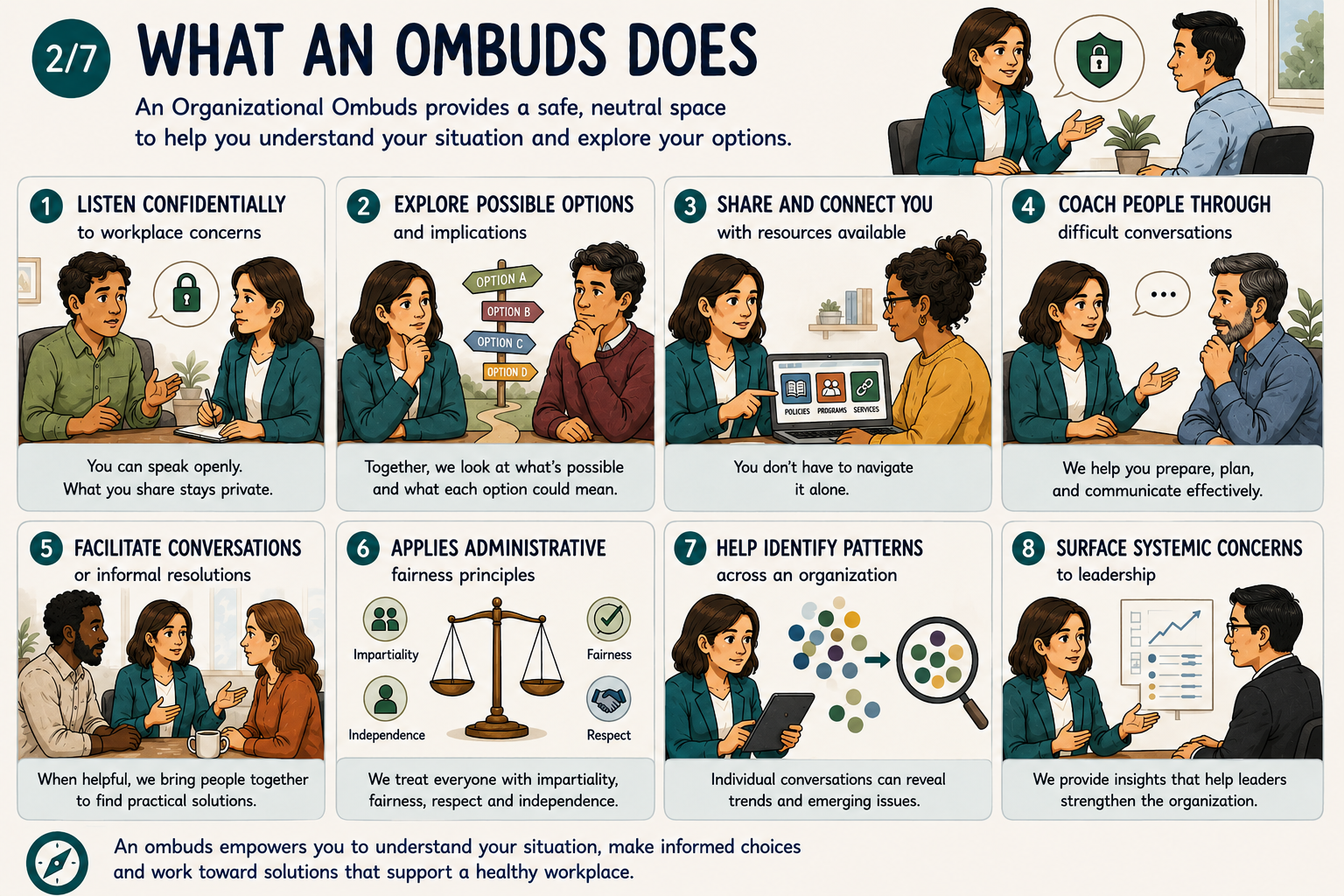
An Organizational Ombuds helps people understand workplace situations, explore possibilities and make informed choices.
That often begins by listening confidentially. Having somewhere to speak candidly can help people organize their thoughts, separate what they know from what they assume, and better understand what is actually concerning them.
From there, the Ombuds can help explore possible options and their implications. There may be several ways forward, ranging from doing nothing for the moment, to having a conversation, seeking assistance from another resource, trying an informal resolution process, or pursuing a formal avenue.
The Ombuds can also share information and connect people with resources. Organizations can be complicated. Employees and managers don't always know what services exist, what different processes do, or where to begin.
Sometimes the most useful intervention is coaching. A person may know that they need to have a difficult conversation but have no idea how to approach it. The Ombuds can help them think through what they want to say, how the other person might hear it, and how they might respond if the conversation becomes difficult.
When appropriate, an Ombuds may also facilitate conversations or informal resolutions, creating a structured environment in which people can better understand one another and work toward practical solutions.
The Ombuds also considers situations through the lens of administrative fairness — including whether people have been treated impartially, respectfully and through fair processes.
And the role extends beyond individual situations.
Because an Ombuds hears from people across an organization, they may be able to identify recurring patterns, emerging issues or systemic concerns that aren't apparent from any single conversation.
Those insights can then be surfaced to leadership while protecting the confidentiality of the people who came forward.
3/7 — What an Organizational Ombuds Doesn't Do
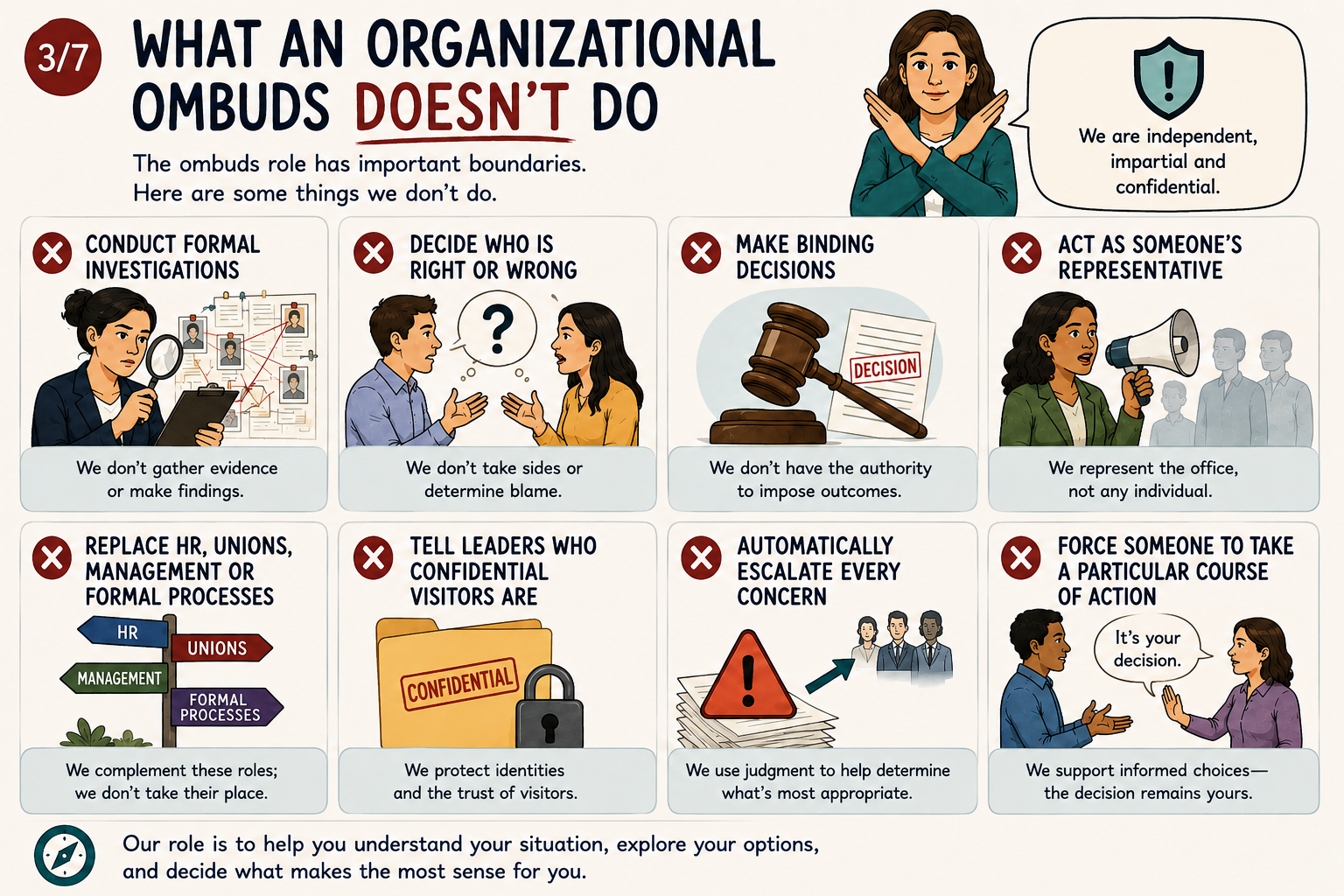
The boundaries of the Ombuds role are just as important as the services it provides.
An Ombuds does not conduct formal investigations. They aren't gathering evidence to make findings about whether an allegation has been substantiated.
They also don't decide who is right or wrong. Impartiality means approaching a situation without advocating for one party over another.
An Ombuds doesn't make binding decisions or impose outcomes. The role does not carry the authority of management, an adjudicator or another formal decision-maker.
Nor does the Ombuds act as someone's representative. They can help someone prepare to advocate for themselves, but they don't become that person's advocate.
The Ombuds also doesn't replace Human Resources, unions, management or formal organizational processes. Those functions have different responsibilities and authorities. The Ombuds complements them by providing another avenue — particularly when someone wants to understand their situation and options before deciding which avenue makes sense.
Confidentiality also creates an important boundary. An Ombuds does not ordinarily tell leaders who has visited the office or disclose what a particular person has shared.
And bringing something to the Ombuds does not mean it will automatically be escalated.
Perhaps most importantly, an Ombuds doesn't force someone to take a particular course of action.
The role is designed to preserve people's ability to make informed choices about their own situation.
4/7 — Not an Investigator
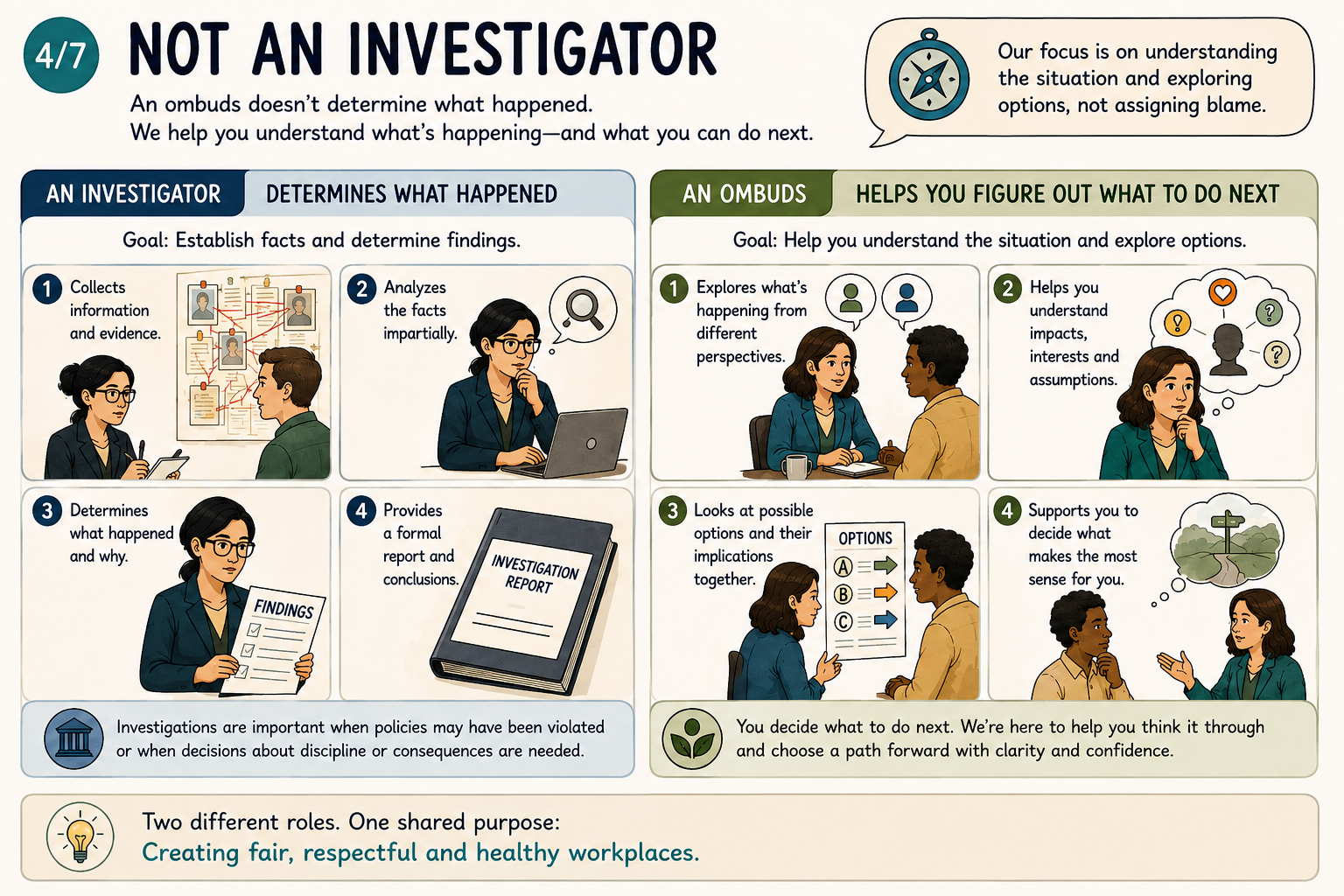
The difference between an Ombuds and an investigator is worth examining more closely because the two roles approach workplace problems from fundamentally different directions.
An investigator is usually asked to answer a question about the past:
What happened?
They may collect evidence, interview witnesses, assess competing accounts, analyze facts and ultimately reach findings or conclusions.
That function is important. Organizations sometimes need to establish facts, determine whether policies or obligations have been breached, and make decisions about consequences.
An Ombuds generally approaches the situation differently.
Rather than determining which account is correct, the Ombuds may explore how different people understand the situation, what interests are involved, what assumptions are being made, what impact the situation is having, and what options are available.
The central question becomes:
What can you do next?
Imagine two employees who describe exactly the same interaction in completely different ways.
An investigation may need to determine which version is supported by the evidence.
An Ombuds doesn't necessarily need to resolve that disagreement.
The Ombuds might instead help someone understand why the relationship has deteriorated, identify what they need from the other person, consider what the other person might need from them, and determine whether there is a realistic path forward.
Sometimes that conversation will reveal that an informal approach makes sense.
Sometimes it will reveal that a formal investigation is exactly what is needed.
The roles aren't competitors. They solve different problems.
5/7 — Neutral Doesn't Mean Passive
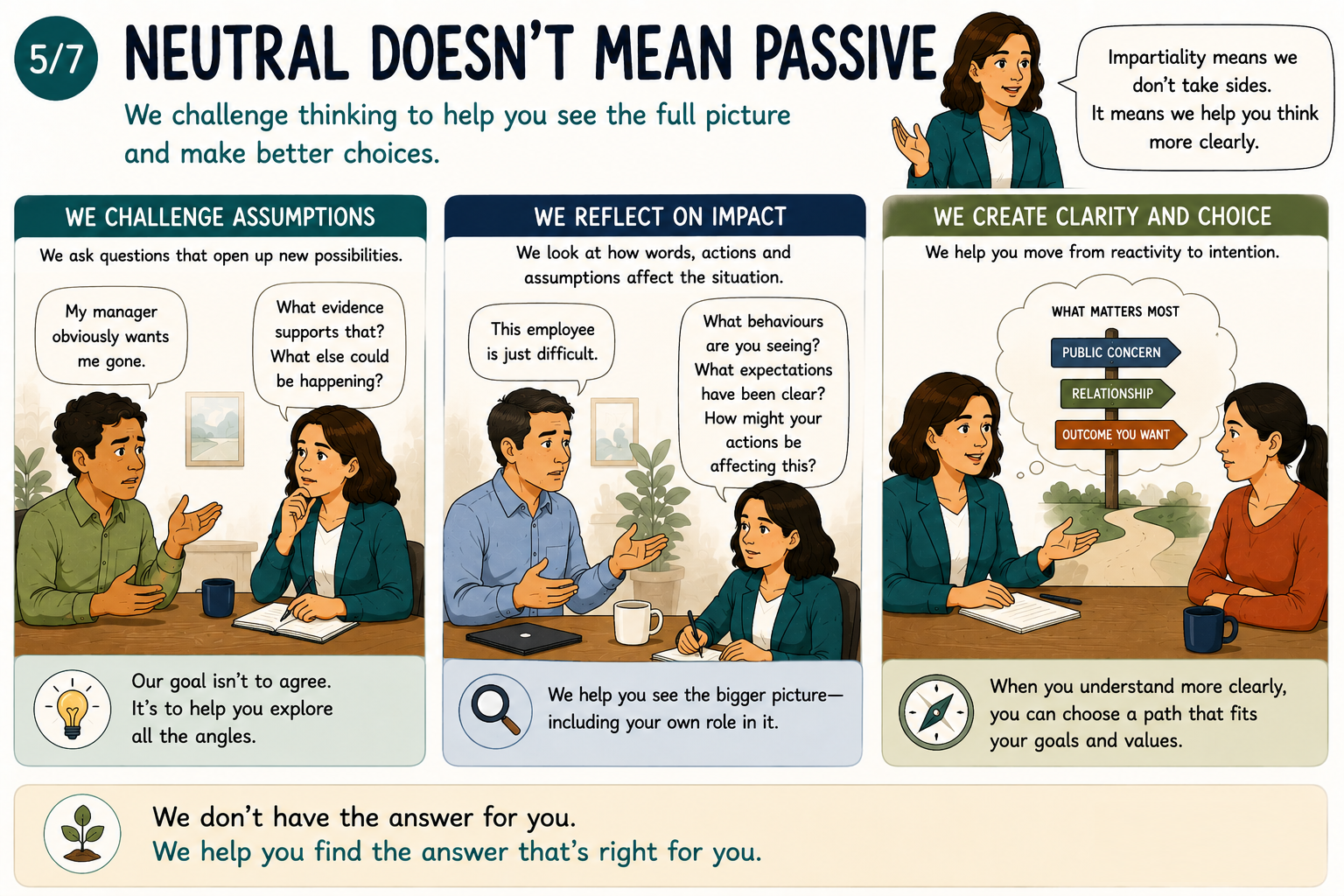
One of the most common misconceptions about impartiality is that it means simply listening without challenging anything.
It doesn't.
An Ombuds can be impartial and still ask difficult questions.
Imagine an employee saying: "My manager obviously wants me gone."
The Ombuds doesn't need to agree or disagree. Instead, they might ask: What have you observed that leads you to that conclusion? What do you know, and what are you assuming? Are there other explanations that might fit what has happened?
The same applies when speaking with managers.
A manager might say: "This employee is just difficult."
The Ombuds might ask what specific behaviours they are observing, what expectations have been communicated, whether those expectations were understood, and how the manager's own actions may be contributing to the situation.
Those aren't neutral questions in the sense of being meaningless or passive.
They are impartial questions.
The Ombuds isn't trying to prove either person wrong. They're helping them see more of the situation than they could see when they walked through the door.
That can include challenging assumptions, considering different perspectives, examining impact, identifying interests and clarifying what outcome actually matters.
The Ombuds doesn't need to have the answer.
The objective is to help people think clearly enough to make better choices for themselves.
6/7 — Seeing What Individuals Can't See
One of the most distinctive contributions of an Organizational Ombuds happens beyond individual cases.
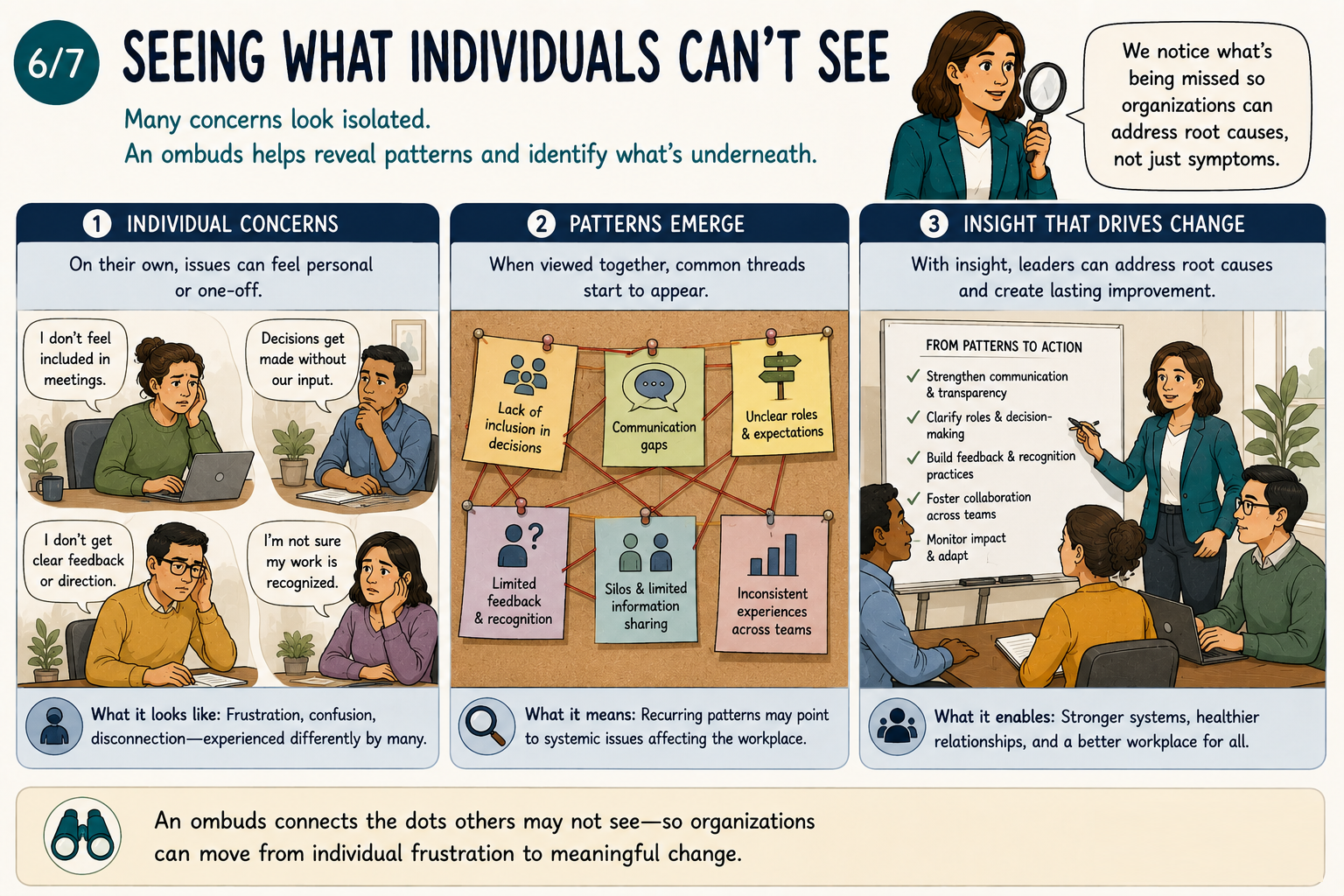
Consider four separate conversations.
One employee says they don't feel included in important meetings.
Another says decisions seem to be made without their team's input.
Someone else says they rarely receive clear feedback or recognition.
A fourth person says they aren't sure how their work connects with another team's responsibilities.
Individually, each situation may look like a personal workplace frustration.
But an Ombuds may hear similar concerns from people in different positions, teams or parts of the organization.
Viewed together, something different begins to appear.
Perhaps there is a communication gap. Perhaps roles and decision-making authorities aren't clear. Perhaps employees don't understand how decisions are made. Perhaps organizational silos are preventing information from moving effectively.
No single conversation proves that a systemic problem exists. But recurring themes can provide an early signal that something deserves attention.
This creates a unique form of organizational intelligence.
The Ombuds can connect dots that individual employees, managers — and sometimes even senior leaders — aren't in a position to see.
Importantly, this can be done without identifying the people behind those conversations.
Instead of telling leadership, "These employees complained about this manager," an Ombuds might say that a recurring theme is emerging around decision-making, communication, workload, psychological safety or another organizational issue.
Leadership can then consider whether something broader needs attention.
The purpose isn't simply to report problems upward.
It's to help the organization move from responding to individual symptoms toward understanding what may be creating them.
7/7 — Bringing It All Together
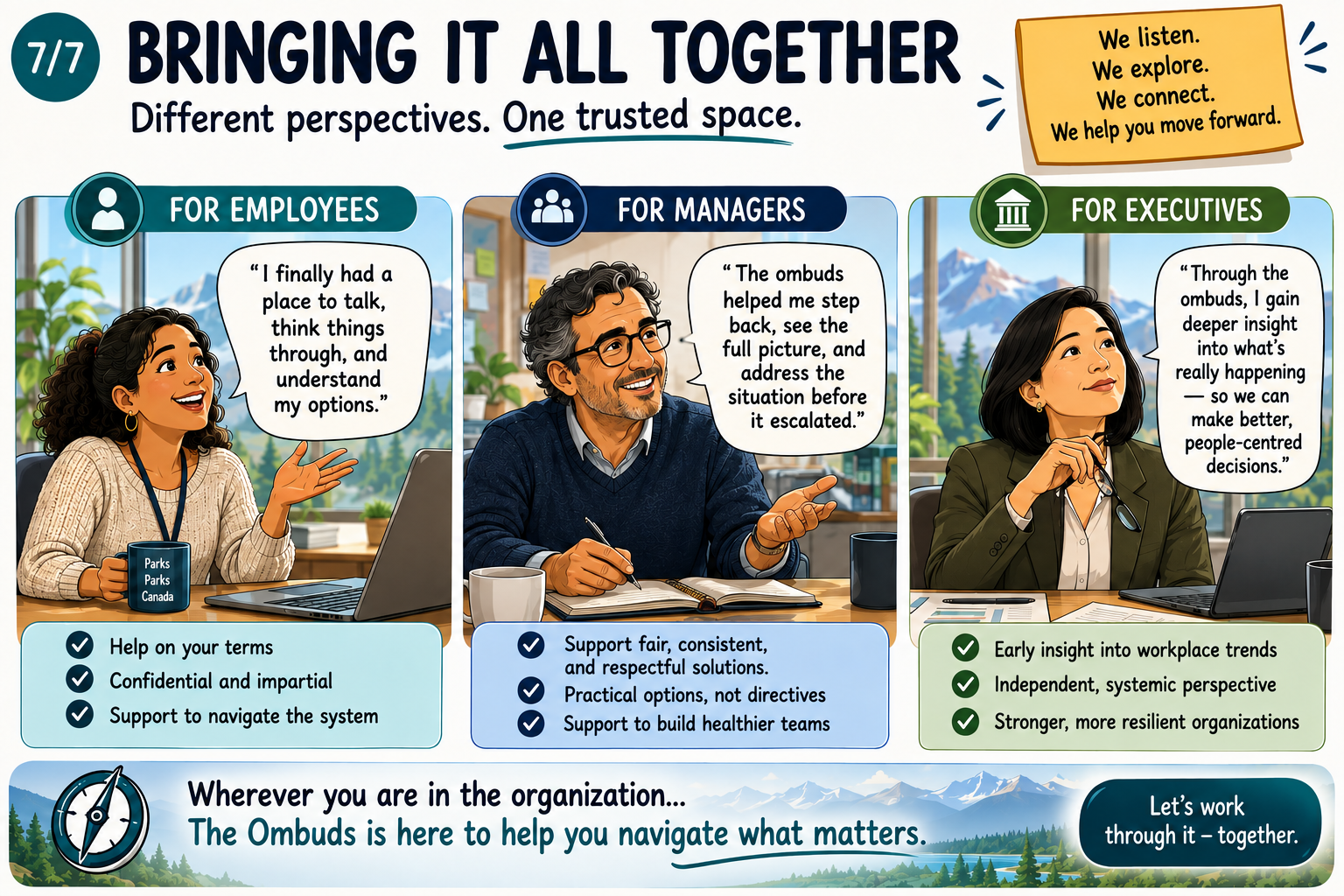
The value of an Organizational Ombuds looks slightly different depending on where you sit in an organization.
For employees, it can mean finally having somewhere confidential to talk, think through what is happening, understand available resources and decide what they want to do.
The help remains on their terms.
For managers, the Ombuds can provide perspective when situations become complicated. Managers can test assumptions, consider different viewpoints, explore practical options and receive support in finding fair, consistent and respectful solutions before problems escalate unnecessarily.
For executives, the Ombuds provides something different again: a window into parts of the organization that traditional reporting mechanisms may not fully capture.
Patterns across confidential conversations can provide early insight into workplace trends, emerging risks and systemic issues — while maintaining the independence and confidentiality that allow people to speak candidly in the first place.
These functions are different, but they share a common purpose.
An Ombuds doesn't take over the problem.
They don't decide the outcome.
And they don't promise that every workplace problem can be resolved.
They provide something simpler, and often extremely valuable:
A trusted place to think before you act.
A place to be heard. A place to challenge assumptions. A place to understand your options. A place to connect with resources. And, when possible, a place to find a path forward.
Wherever you are in the organization, the Ombuds is there to help you navigate what matters.
We listen. We explore. We connect. We help you move forward.